
I’ve been tooling around with AI a lot lately. Like everyone else in marketing, I started by experimenting with the obvious things: writing, brainstorming, research, content ideas, and ways to speed up some of the work I already do.
But lately I’ve been much more interested in a different question:
What happens when AI gets access to the information a business already has?
So I started building a business dashboard. And that’s where this got really interesting.
Most businesses have more data than they realize.
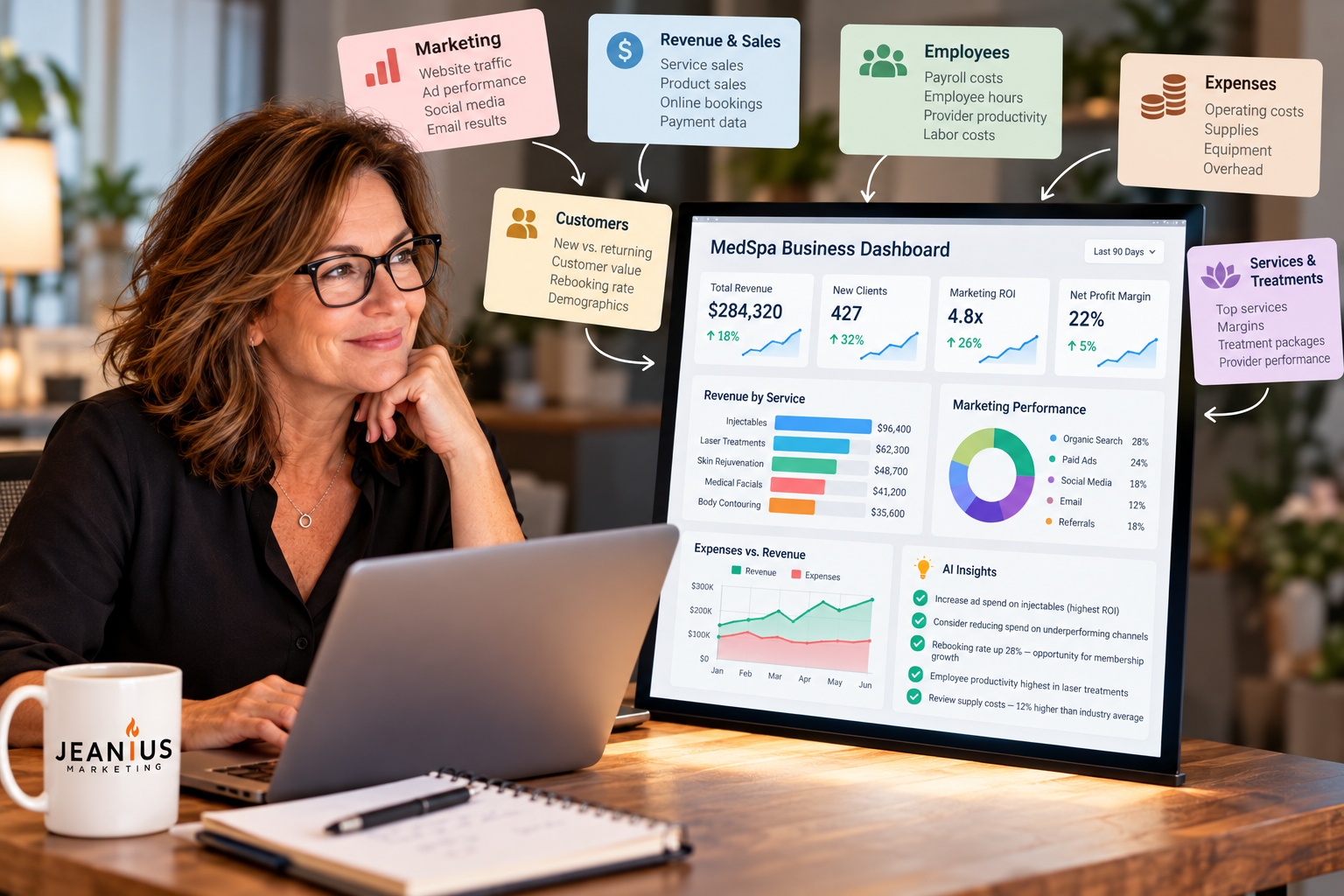
The problem is that it’s scattered everywhere.
Your website has traffic data. Your email platform has opens, clicks, subscribers, and sales. Your ecommerce or POS system knows what people are actually buying. Your advertising platforms know what you’re spending to get people through the door. Social platforms have another collection of numbers.
Then there are your actual business numbers: revenue, expenses, payroll and employee costs, inventory, margins, sales by product or service, customer lists, promotions, and probably a spreadsheet or three.
Most of those systems don’t talk to each other.
So you might know that a particular promotion generated $20,000 in sales — but that doesn’t necessarily tell you whether it was profitable.
You might know which service generates the most revenue — but not which one produces the best margin once you account for the employee time and expenses required to deliver it.
You might know which marketing campaign generated the most clicks — but not whether those clicks turned into customers worth acquiring.
That’s the part I’m interested in.
AI can help you connect the pieces.
Instead of looking at marketing data in isolation, I’m experimenting with bringing different kinds of business data together and asking better questions.
· Which marketing activity is actually contributing to profitable sales?
· Which products or services should we be promoting more aggressively?
· Which ones generate revenue but eat up too much time, labor, or expense?
· Are there customers we’re failing to bring back?
· Are we spending money on marketing that isn’t producing enough return?
· Are employee costs aligned with the parts of the business producing the most revenue?
· Is there an opportunity hiding in the numbers that nobody has noticed?
In other words:
Where should we pour on the gasoline, and where should we cut the dead weight?
That’s a much more interesting use of AI to me than simply asking it to write another blog post.
This is where I think AI gets really useful for small businesses.
Big companies have analysts, marketing departments, expensive reporting systems, and people whose entire job is to find patterns in data.
Most small businesses don’t.
But they still generate enormous amounts of information.
AI is beginning to give smaller businesses the ability to make much better use of it — not just to understand their marketing, but to understand how marketing connects to the rest of the business.
And that’s where I think this gets exciting.
I’m still experimenting, connecting things, breaking things, rebuilding them, and figuring out just how far we can take this.
But I’ve already learned one thing:
The real power of using AI in your marketing may not be creating more stuff. It may be helping you see what your business has been trying to tell you all along.
👉 Want to see what this actually looks like? I built a working demo for a permanent makeup business that pulls all of this scattered data together into one dashboard. DM me and I’ll show you what I built.